In August 2023, we published a forecast of three major trends expected to shape the BC wine industry. Two years later, how did those predictions play out? With two brutal winters behind us, and new initiatives like Crafted in BC emerging, it’s time to reassess where the industry stands.
🍇 Climate Resilience: More Urgent Than Ever
Then: After the extreme cold in December 2022, we predicted a gradual shift toward climate-resilient varietals and vineyard practices.
Now: The damage was far worse than anticipated. Sub–30 °C temperatures decimated vineyards in the Okanagan, with a 56% decline in overall production. Some wineries lost their entire 2023 crop. About 22–29% of vines required replanting.
Still, there was a silver lining: an unusually warm fall helped ripen what little fruit remained, and winemakers produced wines of exceptional concentration and balance.
Takeaway: BC growers are now embracing the need for replanting—but long-term recovery will stretch into the next decade.
🍷 Cabernet Franc: Rising to the Occasion
Then: We saw growing interest in Cabernet Franc due to its cool-climate adaptability and expressive character.
Now: That prediction was spot-on. Acreage devoted to Cabernet Franc has expanded significantly, and the varietal won multiple Gold medals at competitions like the National WineAlign Awards.
Takeaway: Cabernet Franc is no longer a supporting act—it’s quickly becoming a BC signature grape.
🌱 Sustainability & Local Focus: Strengthened by Crisis
Then: Consumers would continue to prioritize ethical sourcing, low-intervention production, and local provenance.
Now: These values have become even more important. The launch of the Crafted in BC designation enabled producers to maintain transparency with consumers while coping with low yields. Sustainability and local-first branding remained cornerstones of marketing and consumer trust.
Takeaway: BC’s identity as a region of place-based, responsible winemaking has only grown stronger in adversity.
📉 Volume Shortfall: Predicted and Then Some
Then: We warned of shortfalls in wine availability through 2025 due to a weak 2023 crop.
Now: The situation escalated quickly. January 2024 brought another catastrophic freeze—wiping out over 90% of the crop. Red wine inventories will remain tight until at least 2026, and the economic toll is estimated at CA $340–445 million.
Takeaway: This is now a full-blown supply crisis. Industry groups, growers, and government agencies are mobilizing to support replanting and stabilization.
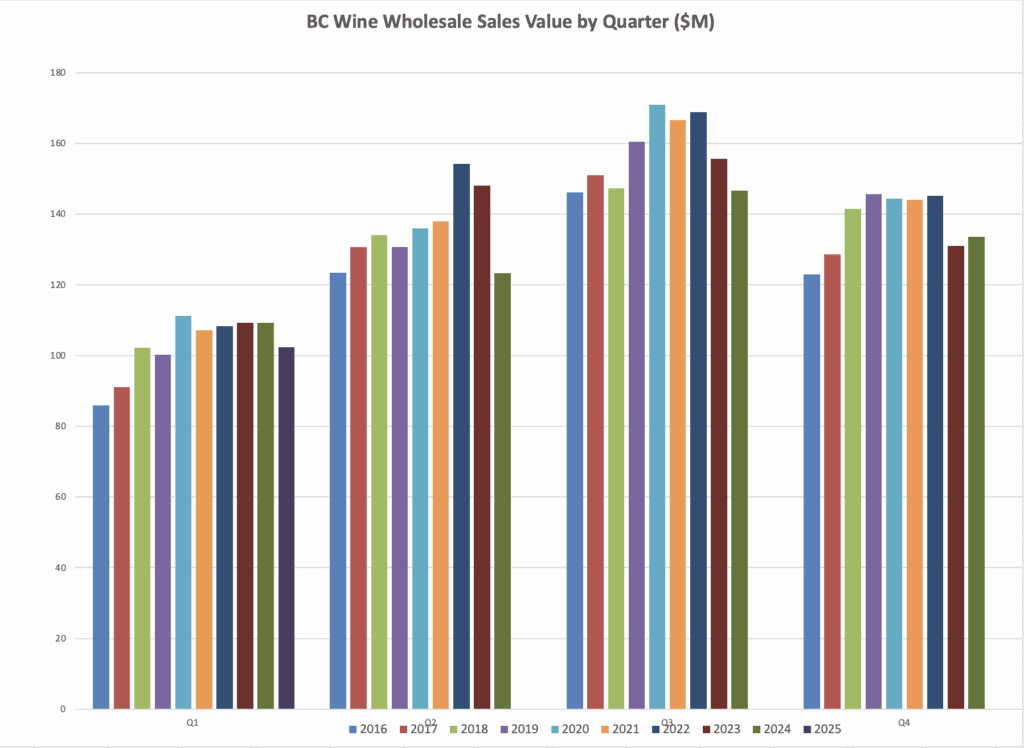
This shortage has impacted BC wine sales with Total Dollar BC Wine sales decreasing 6% in 2023 and 2024.
🧾 Trend Forecast vs. Outcome
| Trend | 2023 Prediction | 2023–24 Outcome | Verdict |
|---|---|---|---|
| Climate Resilience | Gradual varietal shift | Severe losses; slow replanting underway | ⚠️ Still lagging |
| Cabernet Franc | Quality and acreage increase | Confirmed by medals and momentum | ✅ Confirmed |
| Sustainability | Continued consumer focus | Strengthened by “Crafted in BC” | ✅ Reinforced |
| Volume Recovery | Shortfall into 2025 | Worsened by 2024 freeze | ✅ Fully realized |
📣 What’s Next?
As BC wine rebuilds, we’re revisiting key questions:
- Will more growers shift to cold-hardy or hybrid varietals?
- Can Cabernet Franc lead BC’s next red wine era?
- Will the “Crafted in BC” model evolve to serve both quality and transparency?
We want to hear from you—the winemakers, vineyard teams, and industry leaders who’ve weathered this storm. What are you planting? What’s in barrel? What’s giving you hope?
Please reply in the comments below or reach out directly—we’ll feature select perspectives in a future update.
Cheers,
Julian Park
Founder, BCWineTrends.com
📬 julian@bcwinetrends.com
Acknowledgment:
This article was written with the assistance of ChatGPT to support editing and formatting. All data, insights, and commentary were provided by Julian, based on original research and analysis for BC Wine Trends.