
Baco Noir isn’t chasing popularity—and that’s exactly its appeal. One of British Columbia’s rarest red grapes, Baco Noir delivers a vivid expression of high-acid freshness, deep colour, and old-school character that feels refreshingly out of step with today’s polished, oak-driven reds. Typically light to medium-bodied, with gentle tannins and a subtle herbaceous edge, Baco Noir excels both on its own and as a blending partner for softer, fruit-forward varietals.
With just 12 acres planted province-wide, roughly 0.1% of BC’s vineyard land, Baco Noir is a true niche wine. Yet for those who value personality over polish and structure over sweetness, this quietly resilient grape continues to reward the curious and the adventurous.
BC Wineries Producing Baco Noir
The only wineries selling 100% Baco Noir in British Columbia are Ancient Hill Winery and Summerhill Pyramid Winery. I have tried many of the Ancient Hill vintages, and it is a superb wine. The Baco Noir is a gorgeous, bold red colour. The wine has ripe flavours of blueberry and plum with a hint of mocha and a spicy sweetness on the otherwise dry finish. The winery only makes about 140 cases. See my post for details – Ancient Hill for Baco Noir and Jazz
Only two wineries currently bottle 100% Baco Noir in British Columbia: Ancient Hill Winery and Summerhill Pyramid Winery. I’ve tasted multiple vintages from Ancient Hill, and it remains one of the most compelling expressions of the grape in the province. Deeply coloured and visually striking, the wine shows ripe blueberry and plum flavours, layered with subtle mocha notes and a gentle spice that carries through a dry, savoury finish. Production is extremely limited, just 140 cases, making it a true small-lot BC rarity.
For tasting notes and background, see my post: Ancient Hill for Baco Noir and Jazz.
Grape History
The short story is that in the 1880s the American root louse called phylloxera devastated all of Europe’s vineyards. The native European grapevine, Vitis vinifera, had no inborn resistance to this sap-sucking louse –which slowly killed the vines. American grapevines, however, did have an inborn resistance.
Growers everywhere in Europe, nowhere more so than in France, were desperate to find or create vines that could resist phylloxera. For decades, starting in the 1880s, researchers experimented with crossing varieties of Vitis vinifera with various American grape varieties. One of these researchers was Francois Baco (1865-1947). A son of winegrowers who lived in the town of Belus, near the famous Armagnac zone in southwest France.
Although Baco’s day job was as a schoolteacher, his passion was grapevines. For decades he laboriously tried numerous crossings of Vitis vinifera varieties with American species. In 1902, Baco released just such a hybrid, a red grape originally called Baco 1. Today it is known as Baco Noir, a cross between a local white grape Folle Blanche and an unknown American red variety. Folle Blanche is used for the brandies made in Cognac and Armagnac.
Eventually, the French decided to spurn these hybrids, preferring instead to simply graft American rootstocks onto their own European varieties. But Baco Noir made such a tasty red wine, and was so unusually resistant to frigid winter weather, that Baco’s creation now is planted in the Midwest and the East (where cold winters are a problem) as well as in the Canadian provinces of British Columbia and Ontario.
Ontario wineries that produce Baco Noir wines include – Henry of Pelham, Peller Estates, Pelee Island Winery and Sandbanks Estate Winery.
What food goes with Baco Noir?
Barbecued meat, a variety of strong cheeses and cured meats and strawberries rolled in black pepper. The fruitiness of the wine makes it a perfect match for grilled lamb kebabs. Because of its high acidity, Baco Noir wine is excellent with tomato sauce-based dishes. Any sort of rich meaty tomato-based sauce spread on grilled meats, or part of a hearty pasta dish.
BC 100% Baco Noirs
Ancient Hill Baco Noir 2019 ($26)
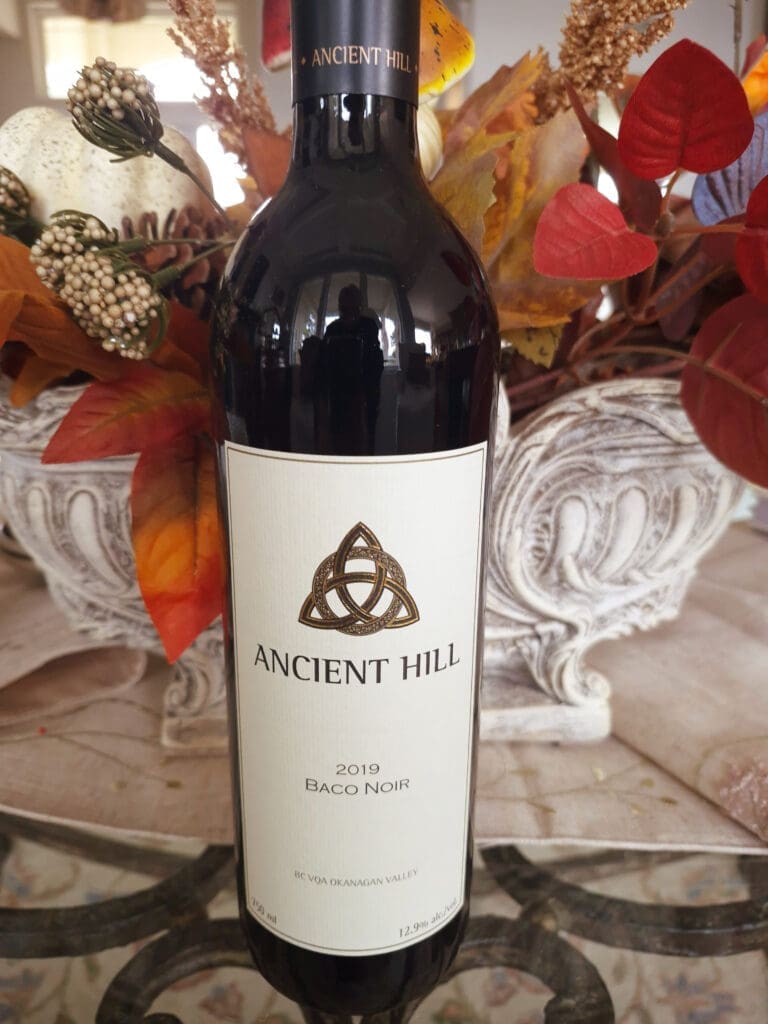
A superb expression of Baco Noir. In the glass, it shows a bold, inky red hue that hints at the richness to come. The nose bursts with ripe black cherry, dark plum, and warm baking spices, layered with chocolate, vanilla, and a touch of butterscotch. On the palate, it’s soft yet powerful, delivering a lush, velvety mouthfeel and a lingering finish that balances fruit intensity with refined spice. 91 Points
A perfect match for grilled lamb or smoky barbecue.
Summerhill Pyramid Heritage Series Organic Baco Noir 2023 ($29)
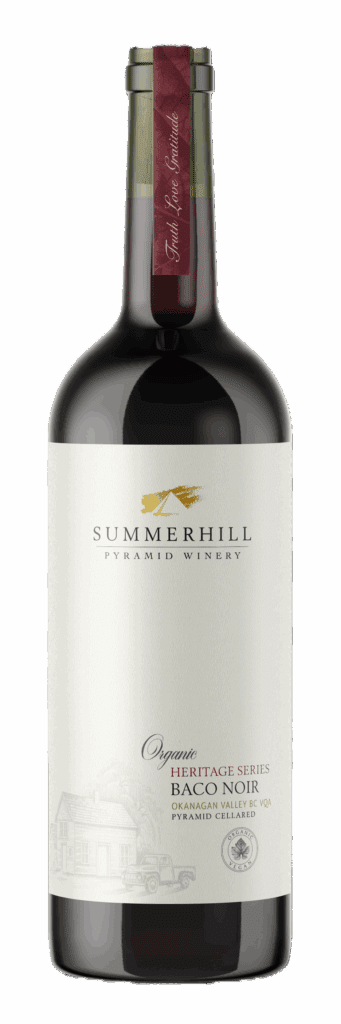
Baco Noir was planted throughout the Okanagan Valley in the 1970s for its hardiness and disease resistance. Most was pulled out in the late ‘80s to make way for the classic European grape varieties. Our neighbour, Elmer Eidse, kept his. Now these old vines are managed organically to create this delicious wine that is a living history of the British Columbia wine industry.
2023 was a very hot vintage in the Okanagan Valley, yielding red wines of fruity intensity with slightly lower acidity and softer tannins then previous years.
The wine fermented in a 10,000L oak foudre. Fermentation completed
naturally, leaving some residual sugar in the wine. Bottled young and fresh!
A full-bodied red with notes of ripe and juicy strawberry, black cherry, dark chocolate, leather and tobacco. The silky tannins of this dry wine balance acidity and a long, long, long finish.